整理之前的笔记...😪
两年前,这门课程的下半部分基本上都学完了,留了一点小尾巴,当时是直接在 iPad 上做的笔记,本来想着时候重新整理一下,结果就是不断放鸽子...(自己的拖延症真的无敌😵)。正好最近有空闲的时间,干脆就把之前的笔记整理好吧。
嗯,另外由于当时做的笔记是直接抄的老师 PPT,所以是英文的,但本文应该会采用中英混合的方式进行描述,估计读起来会有点累(不管了,自己写的舒服就行了😁)。不过,整体的行文脉络会与原来一致。
Unit 7.1 Program Compilation Preview A. Two-tier compilation(like Java) 1 2 3 4 5 6 Java compiler Java program ---------------> VM code(bytecode in Java) | | V JVM implementation
The VM code is an abstraction: write once, run anywhere.
B. Jack compilation(Java-like) 1 2 3 4 5 6 7 Jack compiler Jack program ---------------> VM code | ------ ------ | | V V VM emulator Hack Computer
这一小节主要讲解的内容是 Jack 这门语言的一些特点:Jack 和 Java 很相似,也是采用“双层编译”的思想来设计的,二者都需要将高级语言编写的代码转化为虚拟机代码(VM code)。在 Java 中,虚拟机代码的形式是字节码,执行起来速度比较快;但在 Jack 中,虚拟机代码的形式是一种像是用虚拟机语言编写出来的代码,理解起来比较简单直观。
Unit 7.2 VM Abstraction: The Stack A. Stack ⭐Stack operations:
push: add a plate at the stack’s top.
pop: remove the plate
首先介绍的是在虚拟机中使用最多的一种抽象数据结构——栈(这个数据结构大家基本都熟悉的不能再熟悉了😂),它有两个操作:push和pop,具体这里就不解释了。
B. Stack arithmetic Apply a function f on the stack:
Pops the arguments from the stack.
Computes f on the arguments.
Pushes the result onto the stack.
这里主要在介绍如何使用栈进行运算,一样不细说了,然后引出了关于抽象和实现的观点。
Abstraction/Implementation:
The high-level language is an abstraction.
It can be implemented by a stack machine.
The stack machine is an abstraction.
It can implemented by … Stay tuned.
简言之就是高级语言的抽象可以通过栈来实现,而栈又可以通过更低级的方法来实现(这是一种自顶向下的解决问题的思路)。
C. The Stack machine model Stack machine, manipulated by:
Arithmetic/Logical commands
Memory segment commands
Branching commands
Function commands
整个栈机器 的模型由上述这四部分组成,也就对应着虚拟机语言的四种指令。
D. Arithmetic/Logical commands
Command
Expression
Return value
add
x + y
integer
sub
x - y
integer
neg
-y
integer
eq
x == 0
boolean
gt
x > y
boolean
lt
x < y
boolean
and
x and y
boolean
or
x or y
boolean
not
x not y
boolean
Observation: Any arithmetic or logical expression can be expressed and evaluated by applying some sequence of the above on a stack.
表格中就是本门课程的虚拟机语言所支持的所有算术运算,任意的算术运算和逻辑运算都可以在一个栈上被上述九种基本运算经过特定的计算顺序而实现。
Unit 7.3 VM Abstraction:Memory Segments A. Variable kinds a. Argument variables <-(mapping)-> argument segments
总共有三种变量类型,对应会映射到三个虚拟的内存段上。
B. Memory segments 8 segments: argument/local/static/constant/this/that/pointer/tempi is a non-negative integer.
VM 语言有两个指令:push和pop,这两个指令的语法如上所示。另外,这八个内存段都是虚拟的,不是真实存在的。
Unit 7.4 VM Implementation: the Stack A. The VM abstraction As we mentioned earlier, 8 segments that we have seen is completely imaginary.
B. Pointer manipulation For example:
can be translate:
这一部分主要在讲指针的概念和基本操作,有 C 语言基础的话,还是比较简单的。
C. Stack machine Assumptions:
SP stored in RAM[0]
Stack base addr = 256
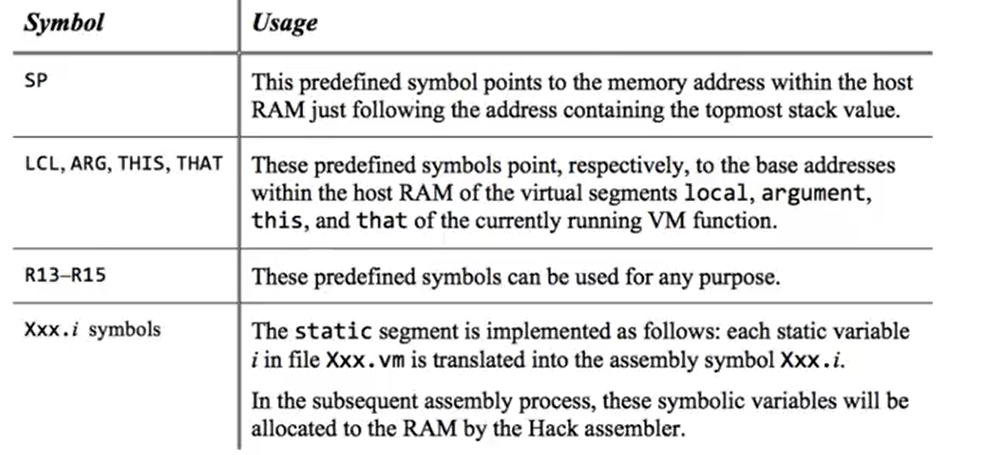
按照上面的假设,在 Hack 中,SP 是栈的栈顶指针,保存在 RAM[0](物理地址 0)这个位置,默认从 256 开始的,
so, push constant 17 can be express in logically psuedo code:
Further, translate to Hack assembly:
1 2 3 4 5 6 7 @17 // D = 17 D=A @SP // *SP = D A=M M=D @SP // SP++ M=M+1
这一部分主要在讲如何把一个push指令翻译为前面学过的汇编语言,理解这个后,就可以推广到所有的算术指令。
D. VM translator perspective VM code translate Assembly code by VM Translator.
Unit 7.5 VM Implementation: Memory Segments A. Implementing local LCL is just a constant number like SP, and it’s also a base address.
1 2 3 4 pop local i -- VM Translator -- addr = LCL + i, SP--, *addr = *sp |---------------> | push local i -- -- addr = LCL + i, *SP = *addr, SP--
这个部分需要我们思考如何将pop/push指令转换为汇编代码,上述代码块中的内容是老师给出的伪码,可以参考这个来手动转换,然后再写到工程代码中即可。大致的过程就是这个样子,具体的代码都写在整个工程中了,这里就不展开了。
B. Implement local, argument, this, that When translating the high-level code of some method into VM code, the compiler:local and argument variables onto the local and argument segmentsobject fields and the array entries that the method is currently processing onto the this and that segments
argument/this/that这三个内存段的实现方式实际上与local是一样的,所以可以采用同样的方式来实现。
C. Memory segment: constant When translating the high-level code of some method into VM code, the compiler:constants into VM operation involving the constant segment.
1 push constant i ---> *SP = i, SP++
对于const这个内存段而言,只有push指令没有pop指令。
D. Memory segment: static When translating the high-level code of some method into VM code, the compiler:static variables that the method sees onto the static segment.
The challenge: static variables should be seen by all the methods in a program.
Have the VM translator translate each VM reference static i (int file Foo.vm) into an assembly reference Foo.i .
Following assembly, the Hack assembler will map these references onto RAM[16], RAM[17], …, RAM[255].
Therefore, the entries of the static segment will end up being mapped onto RAM[16], RAM[17], …, RAM[255], in the order in which they appear in the program.
这块是在讲解用于存储静态变量的 static 内存段的实现,实际上 static 这个虚拟内存段被映射到实地址段 16-255 了。
E. Memory segment: temp When translating the high-level code of some method into VM code, the compiler:
temp implementation: Mapped and RAM locations 5 to 12.
1 2 3 pop temp i -- VM Translator -- addr = 5 + i, SP--, *addr = *SP |---------------> | push temp i -- -- addr = 5 + i, *SP = *addr, SP--
temp 内存段一共有八个地址,被映射到了地址 5-12。
F. Memory segment: pointer When translating the high-level code of some method into VM code, the compiler:
A fixed, 2-place segment:
accessing pointer 0 should be result in accessing THIS
accessing pointer 1 should be result in accessing THAT
1 2 3 push temp i -- VM Translator -- *SP = THIS/THAT, SP++ |---------------> | pop temp i -- -- SP--, THIS/THAT = *SP
THIS是对象的自身的地址,THAT是数组的首地址。
Summary In this chapter, we need to implement:
Arithmetic/Logical commands: add, sub, neg, eq, gt, lt, and, or, not.
Memory access commands: pop/push segment i.
Unit 7.6 The VM Emulator Typical uses of the VM Emulator:
Running(compiled) Jack programs
Testing programs(systematically)
Experimenting with VM commands
Observing the VM internals(stack, memory and segments)
这一小节主要在介绍 VM Emulator 的使用方法,其实与之前的工具差不多。
In order to write a VM translator, we must be familiar with:
the source language
the target language
the VM mapping on the target platform
A. Source: VM language
B. Target: symbolic Hack code
C. Standard VM mapping on the Hack Platform
How to map the VM’s data structures using the host hardware platform
How to express the VM’s commands using the host machine language
Standard mapping:
Specifies how to do the mapping in an agreed-upon way
Benefits:
Compatibility with other software systems
Standard testing
这一小节主要介绍的内容是如何做一个 VM Translator,需要具备三点:
对源语言熟悉
对目标语言熟悉
对目标平台的地址映射关系要熟悉
Unit 7.8 VM Translator: Proposed Implementation Prose design:
Parser: parses each VM command into its lexical elements
CodeWriter: write the assembly code that implements the parsed command
Main: drives the process(VMTranslator)
Main(VMTranslator):
Main logic:
Constructors a Parser to handle the input file
Constructors a CodeWriter to handle the output file
Marches through the input file, parsing each line and generating code form it.
这一小节主要是在介绍 VM Translator 的一些功能和设计思路,详细的设计思路可以看老师的讲解或者查阅老师给的资料。
Unit 7.9 Building the VM Translator, Part I 这个小节主要再讲这个章节需要完成的任务及对应的测试方法。在 VM Translator 做好之后,需要将 Project7 中每个目录下的.vm文件翻译成.asm文件,然后使用 CPUEmulator 加载翻译后的.asm和.tst脚本文件,执行完成后比对生成的.out文件和.cmp文件即可。
Unit 7.10 Perspectives
You mentioned that the VM is a rather old idea. How old is it?
How close is our VM to Java’s JVM?
Both language are stack based, both use their push and pop and both access their memory using virtual memory segments instead of symbolic variables.
About efficiency
Unit 7.11 Project 如前所说,这个章节的任务是实现一个简化版的 VM Translator,只需要支持九个算数指令(Arithmetic Commands)和push/pop指令即可。按照老师的讲解,这个 VM Translator 由两个部分组成:Parser 和 CodeWriter ,具体的功能说明这里不再提及了,直接看代码吧。
main.cpp 1 2 3 4 5 6 7 8 9 10 11 12 13 14 15 16 17 18 19 20 21 22 23 24 25 26 27 28 29 30 31 32 33 34 35 36 37 38 39 40 41 42 43 44 45 46 47 48 49 50 51 52 53 54 55 56 57 58 59 60 61 62 63 64 65 66 #include <algorithm> #include <iostream> #include <windows.h> #include "parser.h" #include "codewriter.h" using namespace std;void parserPath (vector<string>& filenames, string path) bool isDir = true ; for (int i = path.length () - 1 ; i >= 0 ; --i) { if (path[i] == '\\' ) { break ; } else if (path[i] == '.' ) { isDir = false ; } } if (isDir) { path.append ("\\*" ); WIN32_FIND_DATAA data; HANDLE hFind = FindFirstFileA (path.c_str (), &data); do { string t (data.cFileName) ; auto it = t.find (".vm" ); if (it != string::npos) { filenames.push_back (t.substr (0 , it)); } } while (FindNextFileA (hFind, &data)); } else { auto it1 = path.find_last_of ("\\" ); auto it2 = path.find_last_of ("." ); filenames.push_back (path.substr (it1 + 1 , it2 - it1 - 1 )); } } int main (int argc, char ** argv) if (argc > 1 ) { string path (argv[1 ]) ; vector<string> filenames; parserPath (filenames, path); if (filenames.size () == 1 ) { string newfilepath = path.substr (0 , path.find (".vm" )); newfilepath.append (".asm" ); Parser parser (path) ; CodeWriter codewriter (newfilepath) ; codewriter.setFileName (filenames[0 ]); while (parser.hasMoreCommands ()) { parser.advance (); CommandType pcmd = parser.commandType (); if (pcmd == C_ARITHMETIC) { codewriter.writeArithmetic (parser.arg1 ()); } else if (pcmd == C_PUSH || pcmd == C_POP) { codewriter.writePushPop (pcmd, parser.arg2 (), parser.arg3 ()); } } } else { } } else { cout << "please input .vm file path or directory" << endl; } return 0 ; }
在阅读这门课程的书籍时,发现书本上对 VM Translator 的要求是既可以解析单个.vm文件,也可以解析目录下所有.vm文件并保存为一个.asm文件,所以在上述文件中,做好了 windows 系统下对文件名及目录的解析。不过,在看了本章需要测试的内容后,发现都是单个文件,索性就暂时先不写多文件解析的相关代码吧,偷个懒~。
commandtype.h 1 2 3 4 5 6 7 8 9 10 11 12 13 14 15 16 17 #ifndef __COMMANDTYPE_H__ #define __COMMANDTYPE_H__ enum CommandType { C_UNKONWN, C_ARITHMETIC, C_PUSH, C_POP, C_LABEL, C_GOTO, C_IF, C_FUNCTION, C_RETURN, C_CALL, }; #endif
parser.h 1 2 3 4 5 6 7 8 9 10 11 12 13 14 15 16 17 18 19 20 21 22 23 24 25 26 27 28 #ifndef __PARSER_H__ #define __PARSER_H__ #include <fstream> #include <string> #include <vector> #include "commandtype.h" using namespace std;class Parser {public : Parser (const string& filename); ~Parser (); bool hasMoreCommands () void advance () CommandType commandType () ; string arg1 () ; string arg2 () ; uint16_t arg3 () private : ifstream m_ifs; vector<string> m_tokens; }; #endif
parser.cpp 1 2 3 4 5 6 7 8 9 10 11 12 13 14 15 16 17 18 19 20 21 22 23 24 25 26 27 28 29 30 31 32 33 34 35 36 37 38 39 40 41 42 43 44 45 46 47 48 49 50 51 52 53 54 55 56 57 58 59 60 61 62 63 64 65 66 67 68 69 70 71 72 73 74 75 76 77 78 79 80 81 82 83 84 85 86 87 88 89 90 91 92 93 94 95 96 97 #include "parser.h" #include <exception> #include <iostream> #include <regex> #include <sstream> Parser::Parser (const string& filename) { m_ifs.open (filename, ios::in); if (!m_ifs) { throw runtime_error ("Failed to open file: " + filename); } } Parser::~Parser () { m_ifs.close (); } bool Parser::hasMoreCommands () return !m_ifs.eof (); } void Parser::advance () if (!hasMoreCommands ()) return ; m_tokens.clear (); string line; while (getline (m_ifs, line)) { regex endl_re ("\\r*\\n+" ) ; regex space_re ("\\s+" ) ; line = regex_replace (line, endl_re, "" ); line = regex_replace (line, space_re, " " ); stringstream ss (line) ; string token; while (getline (ss, token, ' ' )){ if (token == "//" ) break ; m_tokens.push_back (token); } if (!m_tokens.empty ()) break ; } } CommandType Parser::commandType () { CommandType ret = C_UNKONWN; #define XX(str, type) \ if (m_tokens[0] == str) \ ret = type; if (m_tokens.size () == 1 ) { XX ("add" , C_ARITHMETIC); XX ("sub" , C_ARITHMETIC); XX ("neg" , C_ARITHMETIC); XX ("eq" , C_ARITHMETIC); XX ("gt" , C_ARITHMETIC); XX ("lt" , C_ARITHMETIC); XX ("and" , C_ARITHMETIC); XX ("or" , C_ARITHMETIC); XX ("not" , C_ARITHMETIC); XX ("return" , C_RETURN); } else if (m_tokens.size () == 2 ) { XX ("label" , C_LABEL); XX ("goto" , C_GOTO); XX ("if-goto" , C_IF); } else if (m_tokens.size () == 3 ) { XX ("push" , C_PUSH); XX ("pop" , C_POP); XX ("function" , C_FUNCTION); XX ("call" , C_CALL); } #undef XX return ret; } string Parser::arg1 () { return m_tokens[0 ]; } string Parser::arg2 () { CommandType cmd = commandType (); stringstream ss; if (cmd == C_PUSH || cmd == C_POP || cmd == C_FUNCTION || cmd == C_CALL) { ss << m_tokens[1 ]; } return ss.str (); } uint16_t Parser::arg3 () CommandType cmd = commandType (); uint16_t ret = 0 ; if (cmd == C_PUSH || cmd == C_POP || cmd == C_FUNCTION || cmd == C_CALL) { ret = stoul (m_tokens[2 ]); } return ret; }
codewriter.h 1 2 3 4 5 6 7 8 9 10 11 12 13 14 15 16 17 18 19 20 21 22 23 24 25 26 27 28 29 30 31 32 33 34 35 36 37 38 39 40 41 42 #ifndef __CODEWRITER_H__ #define __CODEWRITER_H__ #include <fstream> #include <string> #include "commandtype.h" using namespace std;class CodeWriter {public : CodeWriter (const string& filename); ~CodeWriter (); static void setFileName (const string& filename) void writeArithmetic (const string& command) void writePushPop (CommandType command, const string& segment, uint16_t index) void Close () private : static string transName (const string &segment) private : static string cd_add () static string cd_sub () static string cd_neg () static string cd_eq () static string cd_gt () static string cd_lt () static string cd_and () static string cd_or () static string cd_not () static string cd_push (const string& segment, uint16_t index) static string cd_pop (const string& segment, uint16_t index) private : ofstream m_ofs; static string m_filename; }; #endif
codewriter.cpp 1 2 3 4 5 6 7 8 9 10 11 12 13 14 15 16 17 18 19 20 21 22 23 24 25 26 27 28 29 30 31 32 33 34 35 36 37 38 39 40 41 42 43 44 45 46 47 48 49 50 51 52 53 54 55 56 57 58 59 60 61 62 63 64 65 66 67 68 69 70 71 72 73 74 75 76 77 78 79 80 81 82 83 84 85 86 87 88 89 90 91 92 93 94 95 96 97 98 99 100 101 102 103 104 105 106 107 108 109 110 111 112 113 114 115 116 117 118 119 120 121 122 123 124 125 126 127 128 129 130 131 132 133 134 135 136 137 138 139 140 141 142 143 144 145 146 147 148 149 150 151 152 153 154 155 156 157 158 159 #include "codewriter.h" #include <functional> #include <iostream> #include <map> #include <sstream> static uint16_t labelCount = 0 ;string CodeWriter::m_filename; CodeWriter::CodeWriter (const string& filename) { m_ofs.open (filename, ios::out); if (!m_ofs) { throw runtime_error ("Failed to open file: " + filename); } } CodeWriter::~CodeWriter () { m_ofs.close (); } void CodeWriter::setFileName (const string& filename) m_filename = filename; } void CodeWriter::writeArithmetic (const string& command) static map<string, function<string()>> s_arithmetics = { {"add" , cd_add}, {"sub" , cd_sub}, {"neg" , cd_neg}, {"eq" , cd_eq}, {"gt" , cd_gt}, {"lt" , cd_lt}, {"and" , cd_and}, {"or" , cd_or}, {"not" , cd_not}, }; m_ofs << s_arithmetics[command]() << '\n' ; } void CodeWriter::writePushPop (CommandType command, const string& segment, uint16_t index) function<string(const string&, int )> cb; if (command == C_PUSH) { cb = cd_push; } else if (command == C_POP) { cb = cd_pop; } m_ofs << cb (segment, index) << '\n' ; } void CodeWriter::Close () m_ofs.close (); } string CodeWriter::transName (const string &segment) { stringstream ss; if (segment == "local" ) ss << "LCL" ; else if (segment == "argument" ) ss << "ARG" ; else if (segment == "this" ) ss << "THIS" ; else if (segment == "that" ) ss << "THAT" ; return ss.str (); } string CodeWriter::cd_add () { return "@SP\nAM=M-1\nD=M\nA=A-1\nM=D+M\n" ; } string CodeWriter::cd_sub () { return "@SP\nAM=M-1\nD=M\nA=A-1\nM=M-D\n" ; } string CodeWriter::cd_neg () { return "@SP\nA=M-1\nM=-M\n" ; } string CodeWriter::cd_eq () { stringstream ss; ss << "@SP\nAM=M-1\nD=M\nA=A-1\nD=M-D\nM=-1\n" << "@eqCMPx" << to_string (labelCount) << "\nD;JEQ\n@SP\nA=M-1\nM=0\n(eqCMPx" << to_string (labelCount) + ")\n" ; ++labelCount; return ss.str (); } string CodeWriter::cd_gt () { stringstream ss; ss << "@SP\nAM=M-1\nD=M\nA=A-1\nD=M-D\nM=-1\n" << "@gtCMPx" + to_string (labelCount) << "\nD;JGT\n@SP\nA=M-1\nM=0\n(gtCMPx" << to_string (labelCount) + ")\n" ; ++labelCount; return ss.str (); } string CodeWriter::cd_lt () { stringstream ss; ss << "@SP\nAM=M-1\nD=M\nA=A-1\nD=M-D\nM=-1\n" << "@ltCMPx" + to_string (labelCount) << "\nD;JLT\n@SP\nA=M-1\nM=0\n(ltCMPx" << to_string (labelCount) + ")\n" ; ++labelCount; return ss.str (); } string CodeWriter::cd_and () { return "@SP\nAM=M-1\nD=M\nA=A-1\nM=D&M\n" ; } string CodeWriter::cd_or () { return "@SP\nAM=M-1\nD=M\nA=A-1\nM=D|M\n" ; } string CodeWriter::cd_not () { return "@SP\nA=M-1\nM=!M\n" ; } string CodeWriter::cd_push (const string& segment, uint16_t index) { stringstream ss; if (segment == "local" || segment == "argument" || segment == "this" || segment == "that" ) { ss << '@' << transName (segment) << "\nD=M\n@" << to_string (index) << "\nA=D+A\nD=M\n@SP\nA=M\nM=D\n@SP\nM=M+1\n" ; } else if (segment == "constant" ) { ss << '@' << to_string (index) << "\nD=A\n@SP\nA=M\nM=D\n@SP\nM=M+1\n" ; } else if (segment == "static" ) { ss << '@' << m_filename << '.' << to_string (index) << "\nD=M\n@SP\nA=M\nM=D\n@SP\nM=M+1\n" ; } else if (segment == "temp" ) { ss << "@5\nD=A\n@" << to_string (index) << "\nA=D+A\n" << "D=M\n@SP\nA=M\nM=D\n@SP\nM=M+1\n" ; } else if (segment == "pointer" ) { if (index == 0 ) ss << "@THIS" ; else ss << "@THAT" ; ss << "\nD=M\n@SP\nA=M\nM=D\n@SP\nM=M+1\n" ; } return ss.str (); } string CodeWriter::cd_pop (const string& segment, uint16_t index) { stringstream ss; if (segment == "local" || segment == "argument" || segment == "this" || segment == "that" ) { ss << '@' << transName (segment) << "\nD=M\n@" << to_string (index) << "\nD=D+A\n@R13\nM=D\n@SP\nAM=M-1\nD=M\n@R13\nA=M\nM=D\n" ; } else if (segment == "static" ) { ss << "@SP\nAM=M-1\nD=M\n@" << m_filename << '.' << to_string (index) << "\nM=D\n" ; } else if (segment == "temp" ) { ss << "@5\nD=A\n@" << to_string (index) << "\nD=D+A\n" << "@R13\nM=D\n@SP\nAM=M-1\nD=M\n@R13\nA=M\nM=D\n" ; } else if (segment == "pointer" ) { ss << "@SP\nAM=M-1\nD=M\n" ; if (index == 0 ) ss << "@THIS\n" ; else ss << "@THAT\n" ; ss << "M=D\n" ; } return ss.str (); }
在做 CodeWriter 这个模块之前,建议先手动写出从 VM 语言转换到 Hack Assembly 的代码,然后再合并到实际的项目代码中。
Summary 最后总结一下,这一章实现了一个虚拟机语言翻译器,功能是将 Hack 平台的 VM Language 翻译为 Hack Assembly Language,目前只支持算数指令和push/pop指令,所以只是个半成品,下一章会将剩余功能补全。.vm文件入手,先用 VMEmulator 模拟一下 vm 代码的实际行为,然后根据这些行为,手动翻译出对应的汇编代码,再合并到项目中即可。
PS:中英混合着写笔记感觉怪怪的,有时候会感觉到思路不连贯🤔...